If these figures are overstated, a business ends up paying more than it should for years without realising it. If they are understated, a business can face a nasty surprise at renewal time, or worse, find itself underinsured at the exact moment a claim needs to be made. Either way, the business loses out.
An insurance audit reviews the records behind your policy, payroll reports, sales figures, asset registers, and confirms they match what has actually been declared to your insurer. This is closely related to the kind of work involved in a standard external audit, since both rely on checking whether reported figures reflect what is actually happening in the business. This matters most for businesses with fluctuating revenue, seasonal staff numbers, or multiple locations, where it is easy for reported figures to drift away from reality without anyone noticing.
Without this kind of check, a business is essentially trusting that its insurance figures were accurate the day they were first calculated, with no real confirmation that they still reflect how the business operates today.
Why Internal Control Testing Protects Everything Else
Insurance only pays out when something has already gone wrong. Internal control in audit work exists to reduce how often that happens in the first place.
Internal controls are the everyday checks that stop mistakes and misuse before they become a real problem. Things like separating who approves a payment from who requests it, requiring sign off above certain spending limits, or reconciling accounts on a regular basis. In smaller businesses, these controls often do not exist formally, simply because nobody has ever mapped out where the gaps might be.
As a business grows, this becomes a bigger issue. More transactions, more staff, and more complexity all increase the chances that a weakness in your processes goes unnoticed until it causes real financial damage. Testing these controls regularly means finding and fixing gaps early, rather than discovering them the hard way after money has already been lost.
There is also a direct link back to insurance here. Insurers often look more favourably on businesses that can demonstrate strong internal controls, since a business with solid processes is statistically less likely to experience the kind of loss that leads to a claim.
Why Risk Assurance Services Tie It All Together
Insurance audits look at what you are currently covered for. Internal control testing looks at whether today’s processes are strong enough. Risk assurance services go a step further and look ahead, helping a business understand what could go wrong in the future before it actually happens.
Every business carries risk, whether it is financial, operational, regulatory, or reputational. Most owners are simply too busy running the business day to day to step back and properly map out where those risks sit. A risk assurance review does that work, looking at things like supply chain exposure, key person dependency, regulatory obligations, and financial risk, then helping build a plan to manage them properly.
This is especially valuable for businesses that are growing quickly, taking on new contracts, or expanding into new markets, since growth almost always brings new risk with it. Businesses that plan for that risk early tend to handle it far better than those who only react once something has already gone wrong.
Why These Three Work Best as a Connected Approach
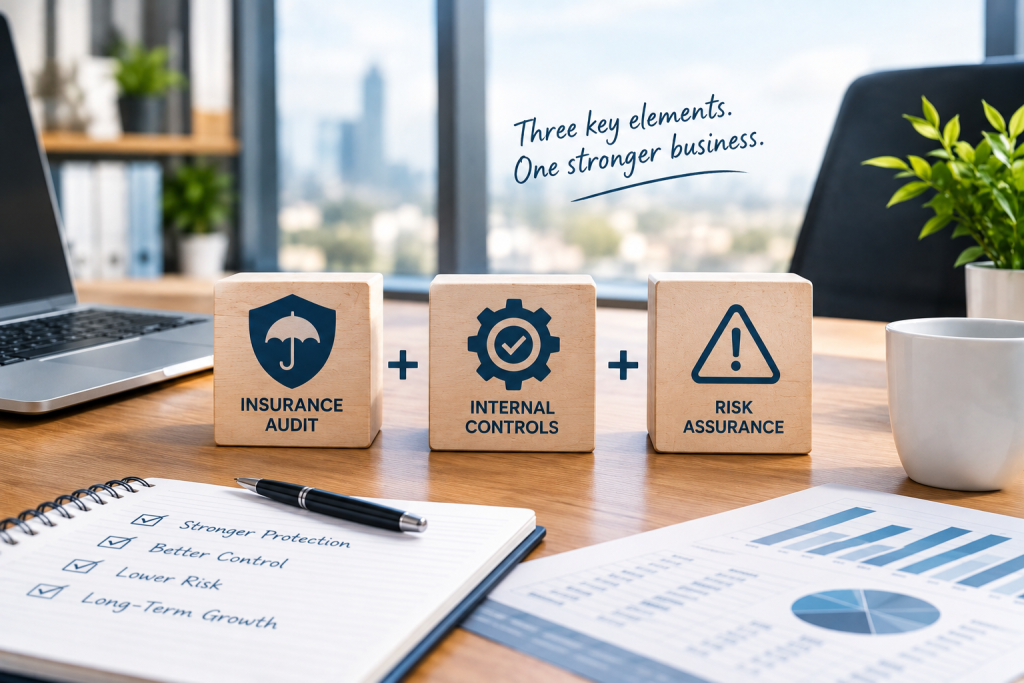
On their own, each of these services solves a different problem. An insurance audit confirms your cover actually matches your business today. Internal control testing reduces how often something goes wrong in the first place. Risk assurance helps you plan for what could go wrong tomorrow. Treated separately, a business only ever sees one piece of the picture. Treated together as part of broader assurance services, they give a much fuller, more honest view of how exposed or how protected a business really is.
Businesses that only think about insurance once a year at renewal time, without ever looking at the controls and risks sitting behind it, are usually missing opportunities to reduce both their risk and their premiums at the same time.
Talk to Assurance and Audit
If your business has never had its insurance figures properly checked, its internal controls tested, or a genuine risk assurance review done, now is a good time to change that. Get in touch with Assurance and Audit today and let our team show you exactly where your business stands.
Frequently Asked Questions
1. What is the difference between an insurance audit and a standard financial audit?
An insurance audit focuses specifically on the figures used to calculate your policy, such as payroll or revenue, to confirm they are accurate. A financial audit looks at the overall accuracy of your business’s financial statements.
2. How often should internal controls be tested?
Many growing businesses find an annual or biannual review works well, though the right frequency depends on how quickly the business is changing and how many staff handle money or approvals.
3. Can weak internal controls actually affect my insurance premiums?
Yes. Insurers often view businesses with strong, demonstrable internal controls as lower risk, which can influence both premium pricing and claims outcomes.
4. Does a small business really need risk assurance services?
Yes, especially if the business is growing, taking on new contracts, or expanding into new markets. Risk assurance helps a business plan ahead rather than only reacting once a problem has occurred.
5. Can these three services be reviewed together?
Yes, and doing so often gives a more accurate and connected picture than treating insurance, internal controls, and risk as three separate, unrelated exercises.